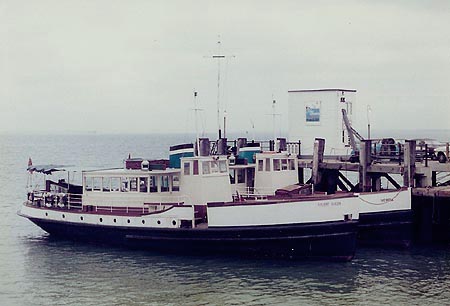
 Verda in use as a house boat
at Shoreham
There
is a second bus on the other side.
Photo:
© John Hendy, 24th February 2008
Click to open larger
image in new window
Verda in use as a house boat
at Shoreham
There
is a second bus on the other side.
Photo:
© John Hendy, 24th February 2008
Click to open larger
image in new window
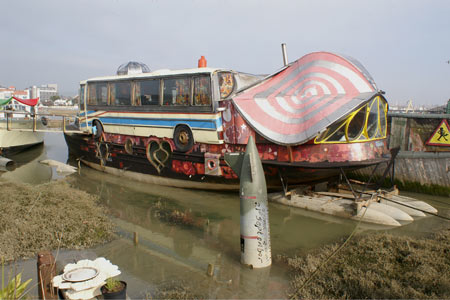
Verda in use as a house boat
at ShorehamPhoto:
© John Hendy, 24th February 2008
Click to open larger
image in new window
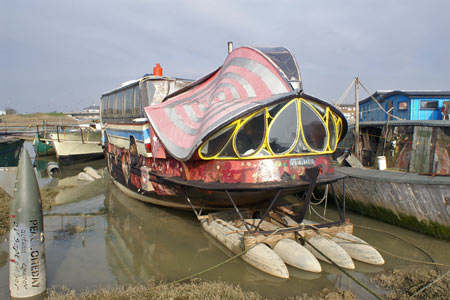
Vadne was built for
the Port of Portsmouth Steam Launch & Towing Company in 1939 by Vosper
of Portsmouth, the first Portsmouth ferry that they built. She was
requisitioned almost immediately by the Navy, and was shipped to
Freetown in 1943, returning to her owners in 1946. In 1961 she passed to
the Portsmouth Harbour Ferry Company. She was retained as a reserve
ferry until 1965 when she was sold to the Gosport Cruising Club for use
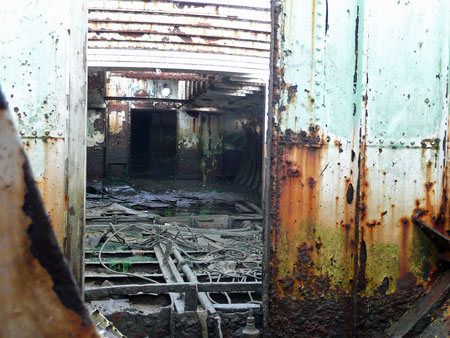
as their headquarters. She remains in derelict condition on the shore at
Forton Lake, Gosport.
Gosport ferry Vadne lying derelict an
the shore of Forton Lake, Gosport
Photo: � Andrew Berry, 7th November 2010,
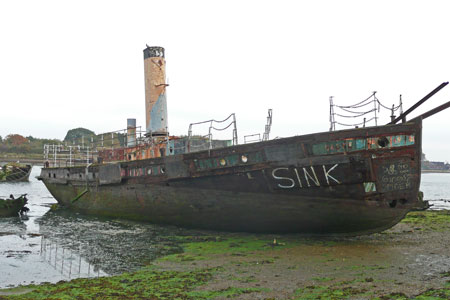
Gosport ferry Vadne lying derelict an
the shore of Forton Lake, Gosport
Photo: � Andrew Berry, 7th November 2010,
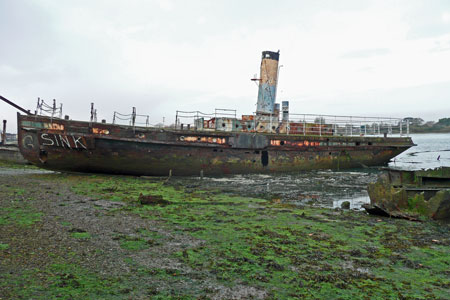
Gosport ferry Vadne lying derelict an
the shore of Forton Lake, Gosport
Photo: � Andrew Berry, 7th November 2010,
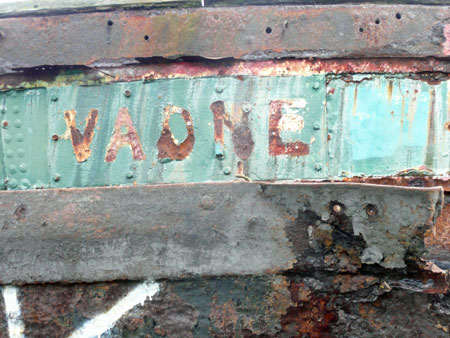
Gosport ferry Vadne lying derelict an
the shore of Forton Lake, Gosport
Photo: � Andrew Berry, 7th November 2010,
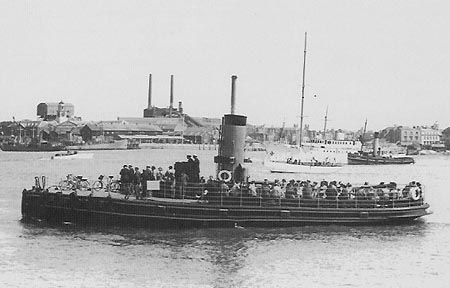
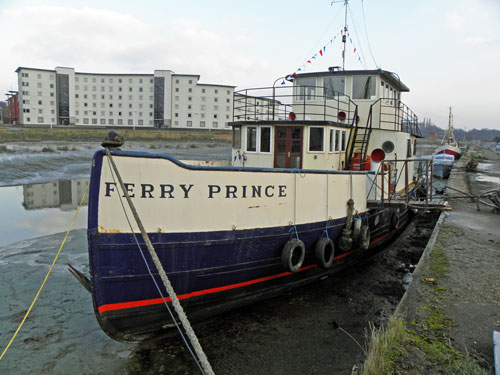
Ferry Prince
(1939-1966)
Ferry Prince was built for the Gosport &
Portsea Waterman's Steam Launch Company in 1939, passing almost
immediately to the Navy for use as an examination vessel. She was
returned in 1941 and returned to ferry service. Maybe all the naval
requisitions had reduced ferry capacity too much. In 1961 she passed to
the Portsmouth Harbour Ferry Company. She was retained as a reserve
ferry until 1966 when she was sold to Thames Pleasure Craft who
initially ran her as a steamship. She was dieselized in 1967. Thames
Pleasure Craft fleet mates in 1981 included
Ferry Princess
and Ferry Queen.
Postcard
of Ferry Prince of the "Old Company".
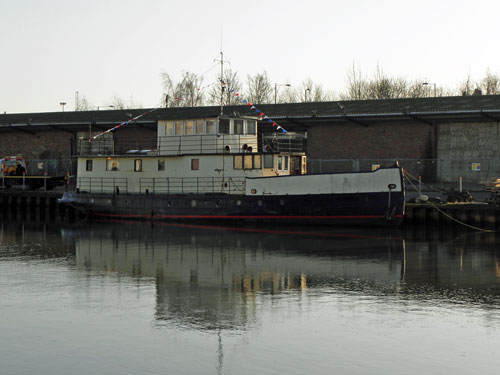
Ferry Prince in use as a house
boat at Colchester in 2012
Photo: �
Derek Sands, 31st January 2012
Venus was built for the Port of
Portsmouth Steam Launch & Towing Company in 1948 by Camper &
Nicholson, Gosport, for the Gosport & Portsea Waterman's Steam Launch
Company in 1948. In 1961 she passed to the Portsmouth Harbour Ferry
Company. She was retained as a reserve ferry and excursion steamer until
1968 when she was sold to Solent Boating Company (Blue Funnel Cruises).
Venus ran as a steamship for
Blue Funnel for
two years before receiving the diesel engines from the Sandringham. She was
sold to Greenwich Pleasurecraft on the Thames in 1978.
Venus in Portsmouth harbour
in June 1974.
Photo:
© Ian Boyle
Click to open larger
image in new window
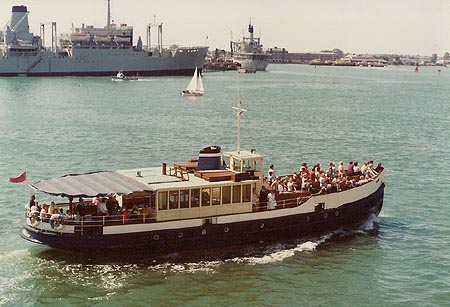
Ferry Princess
(1948-1968)
Ferry Princess was built by Camper &
Nicholson, Gosport, for the Gosport & Portsea Waterman's Steam Launch
Company in 1948. In 1961 she passed to the Portsmouth Harbour Ferry
Company. She was retained as a reserve ferry and excursion steamer until
1968 when she was sold to Thames Pleasure Craft who converted her to
diesel power before entering service. Thames Pleasure Craft fleet mates
in 1981 included
Ferry Prince and
Ferry Queen.
Postcard
of Ferry Princess of the "Old Company".
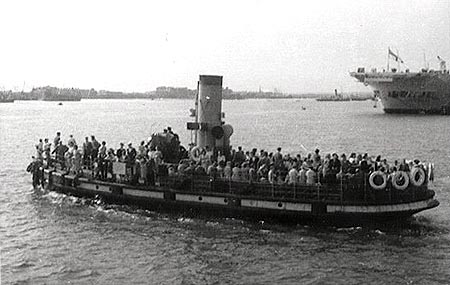
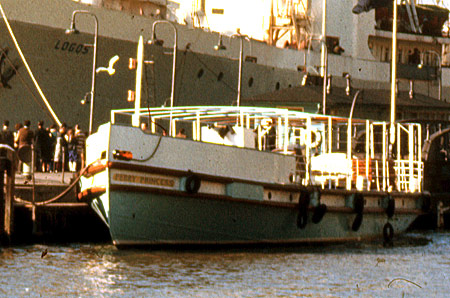
Gosport ferry Ferry Princess
on the Thames at Tower Pier in the 1970s
Diesel Ferries
The three last "traditional"
Portsmouth ferries were the Vesta (1956), Ferry Queen (1959) and
Vita (1960). They were all diesel-powered, but otherwise
the design had changed little in 80 years. All three remain in
service on the Thames, Vesta as the
Duchess M on
the Tilbury-Gravesend ferry, and
Vita &
Ferry
Queen with
City Cruises. Their lives on the Portsmouth-Gosport
ferry were fairly short, being replaced by the Portsmouth
Queen and Gosport
Queen in 1966.
The three vessels were retained until the mid-1970s as reserve
vessels and for use on seasonal harbour tours.
Vesta (1956-1974)
Vesta was sold to Thames Pleasure Craft
in 1974, but was running for
Thames
Launches by 1977.
She passed to Arthur Green as the
Duchess M in 1978, and then to D.C &
W.Tours in 1981. By 1983
Duchess
M was under
the Capital Cruises banner. In 1991 she was on the River
Tyne running charter cruises for Rolls Royce Limousine Hire,
passing to River Tyne Cruises by 1995, when her fleet mates were
the
Catharine (ex-Tilbury-Gravesend) and
Island Scene (ex-Blue Funnel). In 1997
Duchess
M was back
on the Thames at Southend, running services to Queenborough and
Strood, plus local sea cruises. Her running mate was the
Maid
of the Forth. By 1999, Duchess M was the sole fleet
member, and was sold in 2002 to the
Lower Thames & Medway Passenger
Boat Co for use
on the
Tilbury-Gravesend ferry, where she remains in 2006.
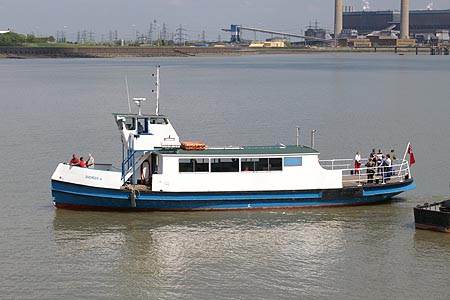
Duchess
M leaving
Gravesend West Street Pier for Tilbury
Photo:
© Ian Boyle, 5th May 2006
Click to open larger
image in new window
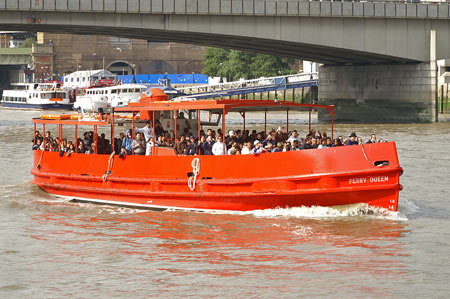
Ferry Queen (2) (1959-1974)
Ferry Queen was built in 1959 for service
on the Portsmouth-Gosport ferry. She was sold to Thames Pleasure
Craft, where she ran with the other ex-Gosport ferries Ferry
Prince and Ferry Princess.
Ferry Queen passed
to City
Cruises c.1995,
and remained with them in 2006. She was offered for sale in 2006
and remained at the boatyard in Isleworth.
Vita saw additional use in 2006 because of this. However,
both Vita and
Ferry Queen saw extensive use in 2007.
More
images of Ferry Queen
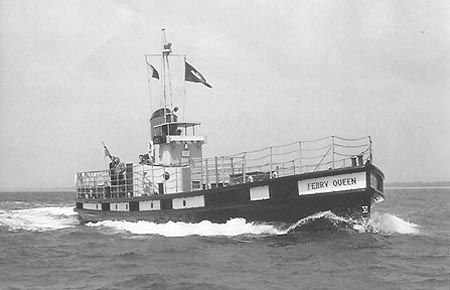
Photograph
of Ferry Queen of the "Old Company" on trials.
Photo:
© Beken of Cowes.
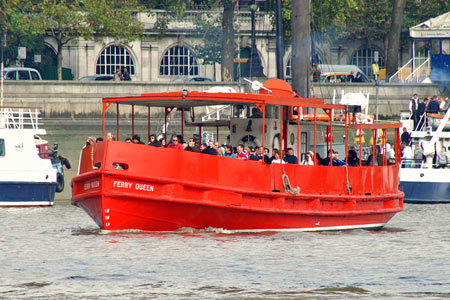
 Ferry
Queen
remains in service on the Thames in 2006 with City Cruises.
Photograph:
©2007 Ian Boyle
Ferry
Queen
remains in service on the Thames in 2006 with City Cruises.
Photograph:
©2007 Ian Boyle
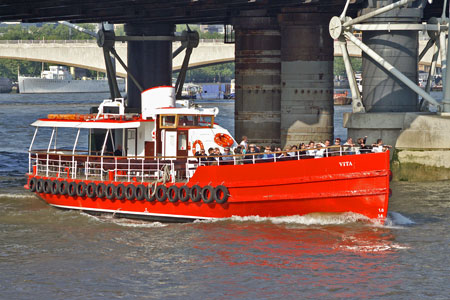
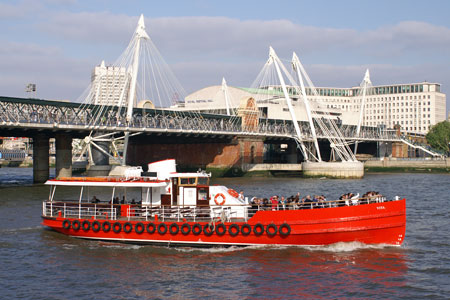
Vita (1960-1974)
Vita was built in 1959 for service
on the Portsmouth-Gosport ferry service. She was the last of
the traditional ferries delivered, albeit diesel-powered from
the start. She was kept as a spare boat on for seasonal harbour
cruises until 1974 after the arrival of the modern Portsmouth
Queen and Gosport
Queen in 1966.
She was bought by
Woods
Cruises for use
on the Thames, passing to
City
Cruises c.1999,
with whom she remained in service until 2009 when she was sold to become a
houseboat.
More
images of Vita
Vita remained in service on
the Thames until 2009 with
City Cruises, but was then sold
for use as a houseboat.
Photograph:
©2007 Ian Boyle.
Blue Funnel Cruises -
Hythe-Southampton Ferries - Portsmouth Harbour
Tours
UK
Excursion Ships
-
Ferry
Postcards
-
Cruise
Ship Postcards
-
Ocean
Liner Postcards
Top
of Page
-
Simplon
Postcards - Recent Updates -
Simplon Postcards
- Home Page